TO GO TO THE NEW HOME OF SPIRITUAL REFLECTIONS PLEASE CLICK ON THE IMAGE

SPIRITUAL REFLECTIONS HAS MOVED!

This blog has moved to Substack. To go to the new site please click on the image above

Tuesday, June 29, 2010

How to Pray - Part 6 : Anthropology of Prayer

Theology is what you think about God. Anthropology is what you think about man - human beings that is, both man and woman. What you think about man affects your prayers as much as what you think about God.

I am indebted to the Chinese theologian Watchman Nee for teaching me Biblical anthropology. Nee says that scripture teaches that man is tripartite - composed of three parts: body, soul and spirit. He gets this idea from such passages as I Thessalonians 5:23 "Now may the God of peace Himself sanctify you completely; and may your whole spirit, soul, and body be preserved blameless at the coming of our Lord Jesus Christ."

This is different from the classic Catholic and Protestant teaching, which says that man is a duality of body and soul. They borrowed that idea from Greek philosophy.

Maybe it doesn't really matter that much. But it helps me to picture these three parts as I pray. I imagine my body as a temple, patterned after the Biblical temple and tabernacle, as the apostle taught: "Do you not know that you are the temple of God and that the Spirit of God dwells in you?"

The Biblical tabernacle was composed of three parts - the outer court, the Holy Place and the Holy of Holies. The outer court was where the bodies of the animal sacrifices were offered to God. The two inner recesses brought one increasingly closer to the presence of God.

I could go into the symbolism of the two inner sanctums (I love details like the table of showbread, the menorah, the altar of incense and the ark of the covenant), but that is probably too much information for most folks. What is important is that you take your own inner journey into the body, through the soul and into the recesses of the spirit.

You are familiar with your body with its five senses. The soul is what we call our personalities, composed of intellect, emotion and will. It is what we normally mean by the word "I." It is our ego. (The Greek word for I is ego.)

The spirit is the innermost part of us. Our spirit is the holy of holies of our earthly bodies. The spirit is the inner I. All three parts are I. We are a unity of body, soul, and spirit. But we often recognize only the body and soul and miss the most important part of us - the spirit.

The spirit has its faculties also: intuition, conscience and communion. It is spirit like the Holy Spirit is spirit, except ours is a human spirit on loan from God. It is the breath of God that gives us life - breathed into us at creation. At death "the spirit returns to God who gave it" as Solomon said. At conversion the Holy Spirit takes up residence in our spirit. In our spirit we have communion with God's Spirit.

To commune with God's Holy Spirit, we must enter into the chamber of our human spirit. Flesh cannot partake of the Kingdom of God. Only spirit can know Spirit. "The Spirit Himself bears witness with our spirit that we are children of God." Prayer is the inward journey into our heart of hearts to commune with the Heart of God.

It takes some practice, but you can find the way. As you pray, go deeper than the body. Go deeper than soul. Leave your ego behind, and "pray in the Spirit." There you will enjoy all the "fruits of the Spirit." There you will learn of God "not in words taught us by human wisdom but in words taught by the Spirit, expressing spiritual truths in spiritual words." There you will meet God.

Monday, June 28, 2010

How to Pray - Part 5 - Spoken Prayer

Francis of Assisi is credited with saying, "Preach the gospel at all times; when necessary use words." I would say the same thing about prayer: Pray at all times; when necessary use words. Sometimes it is necessary to use words in prayer. Words feel clumsy and inadequate when I am before my God, but sometimes they are the best we've got.

The standard acronym to classify the types of verbal prayer is ACTS: Adoration - Confession - Thanksgiving - Supplication. Just like a balanced diet has the five different food groups, the balanced life of prayer includes these four different prayer groups.  If your prayer life does not regularly include all four types, you should probably examine why.

Adoration is praising God for who God is. Confession is repentance for sins committed and good deeds left undone. Thanksgiving is gratitude to God for what God has done for us. Supplication includes both petition - asking God to do certain things for us -- and intercession - asking God to do things for others.

Some people believe that all four elements should be present every time we pray. To me that feels like sitting down to four course dinner every time I want to eat. Sometimes I just want a bowl of cereal or a sandwich. It is important to exercise all four types of prayer regularly, but not necessarily all at the same time.

These are not the "four commandments of prayer." Prayer is more natural than that. It is as natural as breathing or eating. That is why I do not use prayer lists. When I talk to a friend I do not refer to notes; why should I use them with God? I understand why people use prayer lists, but they get in the way of my relationship with God.

I figure that Jesus was right when he said that God knows what we need before we ask. I don't need a script to make sure all the bases are covered. I pray for certain people every day - those closest to my heart. I pray for others occasionally, "as the Spirit moves me" - literally. 

Most of all I do not worry about the people I pray for. Worried prayer is a contradiction in terms. If you are worrying, you aren't praying  - and vice versa. Worry and doubt counteract the whole purpose of prayer. If you can't pray in faith, then why pray? "Therefore I tell you, whatever you ask in prayer, believe that you have received it, and it will be yours."

Prayer is entrusting our concerns into the hands of God. Authentic prayer is natural, spontaneous, and heartfelt. Ultimately it is surrendering our will to the Father's will. As Jesus prayed, "Not my will, but Thine be done." That is why so-called "unanswered prayer" is not an issue for me. I am always praying for God's will to be done; how could that prayer not be answered?

In the end even verbal prayer breaks down into groans for me. My memory and my words fail me and my heart pours out the unutterable desires of my heart. "Likewise the Spirit helps us in our weakness. For we do not know what to pray for as we ought, but the Spirit himself intercedes for us with groanings too deep for words." The Spirit intercedes for me according to the will of God. And I know the Spirit's prayers will be answered.
_________________
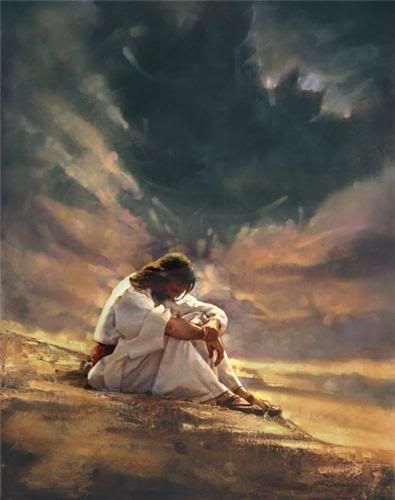
Art is "Jesus Praying" Sandy Brunson

Saturday, June 26, 2010

How To Pray - Part 4 : Silent Prayer

There are two types of prayer. One is with words and the other is without words. Of the two I prefer the wordless.  I have found that the best way to pray is to say nothing. I seem to communicate better that way. Perhaps it is more accurate to say that God is able to communicate with me better when I keep the chatter down. I use words when necessary. I always end my time of prayer with a few minutes of words, but I prefer not employ that limited form of communication.

When instructing his disciples about prayer Jesus said, "And when you pray, do not use vain repetitions as the heathen do. For they think that they will be heard for their many words. Therefore do not be like them. For your Father knows the things you have need of before you ask Him." Prayer is not informing God of what he doesn't know or may have forgotten. It is not stroking the divine ego or reminding the Lord of his earthly responsibilities. Prayer is getting out of our own way and making room for God.

When I pray, I spend the majority of my time simply being present to God. When I am not praying, I am wrapped up in my own thoughts and concerns. When I am going about my daily activities, it is like I am in a trance. I am caught in the busyness of the personality program that I call me. As George Harrison sang: "All thru' the day I me mine, I me mine, I me mine. All thru' the night I me mine, I me mine, I me mine." During prayer I wake up from the trance.

Prayer is the time to turn off the "I Me Mine" solo and listen to God's tune. God's song is not difficult to hear. It is playing all the time in the background. All of life is God's song. Nature sings it. Humans move to it. It is the harmony of everything. Our problem is that we don't pay attention to it.

Most people have not paid attention to it for so long that they do not even notice it playing. It is like people are tone deaf. They have tuned out God's voice. Prayer is bringing God's background music to the foreground and allowing our miserable melodies to fade into the background.

I like to describe it as Presence. It is like when you are busy doing something and you become aware that someone has entered the room, but you haven't turned to greet them yet. Prayer is turning around to greet God, who has been here all the time. God is present everywhere always. We are just not conscious of his presence. Prayer is paying attention to the God whom we normally ignore.

When you pray, stop paying attention to your own thoughts and pay attention to God. God speaks in a still small voice, so you have to listen carefully. That means you have to stop listening to yourself. You can't stop your mind from thinking. I have tried that; it doesn't work. Your mind will keep spewing thoughts no matter how much you tell it to stop. It is best to let your mind babble, but just ignore the babblings. Move your attention from the inner dialogue and to God's silent presence.

It is that simple ... and that difficult. In the presence of God I am sane. My normal state of consciousness feels like a form of insanity in comparison. In silent prayer I wake up. I am conscious in a way that makes my normal waking state feel like sleep. I am mentally aware in a way that makes normal awareness feel like unconsciousness. This awareness of the all-consuming presence of God is the most profound form of prayer. 
____________________
Art is "Silent Prayer" by Lisa Gao, Oil on canvas

Friday, June 25, 2010

How To Pray - Part 3 - The Basis of Prayer

Prayer begins before we ever kneel or sit to pray. It begins with our theology. Everyone has a theology. You might not be able to articulate it, but you have one. You can feel it working when you begin to pray. Your theology either facilitates your openness to God or hinders it.

Theology is what you think about God. If you think God is far away, your prayers will never reach God. If you think you need special words or holy thoughts to be heard by God, then your words and thoughts will keep you from God. If you believe that God judges you for your sins, then your guilt will separate you from God. If you think God is obligated to answer your prayers, then your self-righteousness will keep you from God.

Different religions have different bases for prayer. I will not debate them here. As a Christian the basis on which I approach God is Christ. I pray in Christ through Christ for the sake of Christ. That is what it means to prayer in the name of Jesus. It does not mean to add "in Jesus' name" as an addendum. Christ is the "all in all" of prayer.

As Patrick of Ireland prayed: "Christ be with me, Christ within me, Christ behind me, Christ before me, Christ beside me, Christ to win me, Christ to comfort and restore me. Christ beneath me, Christ above me...." Christ alone is my theology of prayer.

Christ prays in me through me for me. When I am in prayer "it is no longer I who live but Christ who lives in me." I have access to God through Christ. I have "boldness to enter the Holiest by the blood of Jesus, by a new and living way which He consecrated for us, through the veil, that is, His flesh."

When I shut the door of my room to pray, another door opens. I close the door to the distractions of the world, and Christ opens the door to heaven. While "in the Spirit" on the island of Patmos, the apostle John says, "I saw a door standing open in heaven." Jesus says, "I have set before you an open door, and no one can shut it."

The blood of Christ has completely taken away the sins that separated me from God. There is no barrier between earth and heaven. The Kingdom of God is here now. I experience this spiritual reality as clearly as I see physical objects. The death of Christ has removed every barrier to intimacy with God. Every doubt and fear that can hinder my approach God has been dealt with - once for all - in the death of Christ.

With Christ as the basis of prayer, I open my heart to God confident that no power in heaven or earth can separate me from the love of God which is in Christ Jesus. By the sacrifice of Christ, my soul is an open door into the throne room of God. There is no fear, no doubt, no barriers. Just communion with the Lord who loves me so much that he gave his life for me. "If God is for us, who can be against us? He who did not spare His own Son, but delivered Him up for us all, how shall He not with Him also freely give us all things?"

Wednesday, June 23, 2010

How to Pray - Part 2 : The Place of Prayer

Once you have decided to begin a discipline of prayer, you need a place to pray. It is true that you can pray anywhere anytime. In fact the apostle Paul urges us to "pray without ceasing." But it is also important to spend some "quality time" alone with God each day. It is best to reserve a regular time and place each day for prayer.

Jesus instructs us, "But you, when you pray, go into your room, and when you have shut your door, pray to your Father who is in the secret place; and your Father who sees in secret will reward you openly."

Privacy seems to be an issue with Jesus. It fosters honesty with God and ourselves. That does not mean you can't pray with people at other times, but one's primary practice of prayer needs to be solo. Prayer is a private audience with God.

I set aside a time - normally in the early evening or late afternoon - to pray. I also do spiritual practice in the mornings after breakfast. But that early session is spent more in reading, thinking, and writing than praying. Bible and devotional reading are helpful, but they can easily crowd out prayer. There needs to be a time reserved exclusively for direct communion with God.

I go into our spare bedroom, which also doubles as a study. I notify my wife that I will be incommunicado for the next half-hour or more, and I shut the door. Then I do nothing but pray to my Father in secret.

I do not answer the phone. I do not read scripture. I do not take notes on anything I discover during prayer... no matter how earth-shattering my insights might seem to be. I figure if my ideas are really that important I will remember them later. This prevents me from turning my prayer time into a brainstorming session.

I prefer to kneel during prayer. The posture of prayer is a cultural thing. The Bible describes people standing to pray; that is the Jewish custom. Eastern cultures sit during prayer and meditation. I recently saw a photo of the Dalai Lama lying prostrate before a statue of the Buddha in the traditional Tibetan posture of prayer. Personally, kneeling inclines my mind and heart to an attitude of worship, submission and receptivity.

I use a kneeling bench that I built ten years ago out of 2x10 pine boards when I was receiving training in spiritual direction at the Shalem Institute. With this simple stool I can sit in a kneeling position without having the whole weight of my body on my knees and legs. This way I can kneel for an extended period of time without discomfort. It also naturally straightens my back and neck, so I am both comfortable and alert.

I also use a timer. I have an app on my old Palm Pilot called a Doan Meditation Timer. There are such programs for iPods, iPhones and iPads. After 30 minutes a chime gently sounds, reminding me how long I have been praying. You may not want to use a timer. Personally I easily lose track of time during prayer. I find myself wondering if I have been praying for an hour or only ten minutes. This device helps me forget about the clock and not be tempted to glance at my watch. For me 30 minutes is a minimum; I often continue well beyond the chime. You may want to begin with fifteen or twenty minutes.

In a future blog I will explain what to do during this time of prayer. But for now, just go into your secret place, shut the door and open your heart to God. The Spirit will do the rest.

Tuesday, June 22, 2010

How to Pray - Part 1 : To Pray or Not to Pray

Prayer has become the centerpiece of my life. Yet there have been times when I neglected this spiritual discipline. I know from my years in ministry that many otherwise "spiritual" people do not pray - at least not very much. Because I believe that prayer is so vital to a healthy spiritual life, today  I am beginning a series of blogs entitled "How to Pray."

The first rule of prayer is simple: Pray. It is of secondary importance how you pray. What matters is that you pray. Just do it. Decide now that you will pray every day no matter what. Make prayer a priority - as important as other things that you deem necessary to do on a daily basis. As important as eating or drinking, working or sleeping, watching television, exercising, reading the news, or checking Facebook.

To say that you do not have the time to pray is a cop out. We all have time to pray. You have the time because you can pray anytime, anywhere, while doing anything. You can pray while driving your car or eating your breakfast. If you can multi-task doing other things, you can multi-task at prayer.

It is certainly more beneficial if you devote a period of time exclusively to prayer. (We will talk about that later.) But for now it is more important that you begin to pray. If you haven't a clue how to pray, just be as quiet as you can for a little while instead. Don't worry about words.

Pray now. Stop reading this blog, look at the time in the lower right corner of your computer, and for the next two minutes pray....

Good. See, you have already started... some of you, that is. Most of you could not stop reading this blog for two minutes to pray. So once again, look at the time and pray for just one minute. Humor me. Do it this time....

Good, at least some of you did it this time. Now decide that you will pray at least that much every day. Decide that prayer is important enough that you will find time to pray every day - more than just a minute or two.

What is it that keeps us from praying? People give lots of reasons, but I think the fundamental reason is that they are afraid. We are afraid of what we will discover. We are afraid of where prayer will take us. We know intuitively that we will have to face ourselves. That is one thing that most people avoid at all costs.

I will be honest with you; the fear is justified. At first you will not like what you see. You will see what you really are, and you will be shocked. I guarantee it. But if you persevere a little bit, the fear will turn to wonder. You will absolutely love what you find in prayer.

But you have to accept the bad news before you can hear the good news. Most people are not willing to do that. We get a glimpse of our real face in the mirror of our souls, and decide it is better to take the blue pill and stay in the matrix.

Most people are more comfortable living an illusory life of self-deception and ignorance than one of truth and freedom. That is why most people do not pray. But if you want to know the truth and be set free, then take the red pill and pray. You will not be sorry.

Monday, June 21, 2010

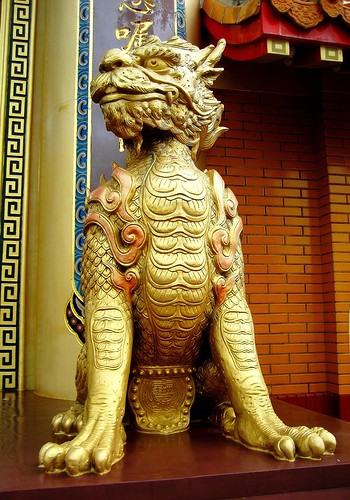
Temple Guardians

They are called dvarapala. They are the temple guardians that are found - often in pairs - outside temples in the Far East. We see them in the Middle East as griffins or sphinxes in friezes on ancient temple entrances. Even the Jewish temple of Solomon had cherubim that stood on either side of the ark of the covenant. The guardians were also stylized as the two brass pillars that flanked the entrance of the Jerusalem temple. The pillars were given the names Jachin and Boaz, as if they were divine personalities.

In Europe and Great Britain the temple guardians appear in the form of gargoyles and grotesques on cathedrals and other buildings. But nowadays they are more often comic than scary. The guardians are secularized as stone lions or other animals flanking the steps of libraries and museums.

Traditionally temple guardians are ferocious looking creatures. Their origin and purpose are unknown, but theories abound. I have my own theory. I think they represent the fear that humans experience when they approach the divine. Theologian Rudolf Otto called it mysterium tremendum - the mystery that causes us to tremble. The Scriptures call it "the fear of the Lord."

Fear of God is not socially acceptable in the West any longer. Western religion has become a domesticated, rational, and sentimental thing. There is nothing to be afraid of in churches. Even Western forms of Eastern religions like Buddhism and Hinduism have lost the fearsome dvarapala. It has been replaced with political correctness. People are afraid of offending some social group in American society, but no longer afraid of offending God.

"Fear and trembling" is an essential part of the religious experience. Without it, we are playing spiritual games rather than actually encountering the divine.  In my personal experience, there is something in me that fears approaching God. As I approach the holy of holies of my own soul where God resides as Holy Spirit, I instinctively shrink back.

I find excuses not to pray. If I pray, then I shield myself with words and thoughts - anything to silence the Silence that calls me to draw closer. To approach the innermost recesses of God within me is scary. It is like peering over the edge of a cliff into infinity. I tremble.

But when I face my fears and enter the holiest place in the confidence of the blood of Christ, the fear evaporates. Perfect love casts out all fear. The unconscious anxiety that drives so much of my life falls away. The temple guardians become messengers of God ushering me into the presence of the Lord.

In the holy place are love, peace and joy. They are always there in the deepest part of my soul. Only my fears keep me from them. Why are we so reluctant to enter this inner spiritual sanctuary? Because to enter, we must leave our earthly selves behind. That is why the cherubim keep guard. Flesh and blood cannot inherit the kingdom of God. Only spirit can commune with Spirit. Only through dying to self do we enter the Kingdom of God.
_______________
Image is Temple guardians at the Holy Glory Temple in Tainan County, Taiwan.