TO GO TO THE NEW HOME OF SPIRITUAL REFLECTIONS PLEASE CLICK ON THE IMAGE

SPIRITUAL REFLECTIONS HAS MOVED!

This blog has moved to Substack. To go to the new site please click on the image above

Friday, January 28, 2022

Julian & the Pandemic

The fourteenth century English mystic, Julian of Norwich can teach us a lot about the pandemic. She was born in 1342. When she was six years old the bubonic plague hit England. By the time she was eight the plague had killed half of the English population. When she reached twenty years of age a second wave of the epidemic swept across the land, killing a quarter of the remaining population.

We do not know much about her early life, but it is thought that she lost her husband and possibly children to the plague. When she was thirty, she became seriously ill and nearly died. While in the heat of fever she had a series of visions of Jesus that transformed her life.

She recovered from her illness and recorded the visions in two works, a shorter and a longer version, entitled Revelations of Divine Love. At the same time that Chaucer was writing Canterbury Tales, Dame Julian was writing her Revelations. They are the earliest known writings by any woman in English.

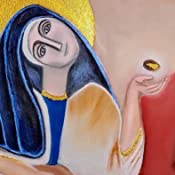
There is much that is extraordinary about her Revelations. In one of the visions Jesus hands her a tiny round object, “a little thing, the size of a hazel nut.” She asks Jesus what it is, and he replies that it is the universe. His exact words were “It is all that is made.” She is afraid that she might drop it, but Jesus reassures her saying, “It lasts, and ever shall, because God loves it. And so, all things have their being in the love of God.”

In the visions she struggles with the age-old problem of suffering. She asks Jesus about all the pain and suffering in the world and receives an answer. “See, I am God. See, I am in all things. See, I do all things. See, I never removed my hands from my works, nor never shall, without end. I lead all things to the end I ordained for them from the beginning, by the same might, wisdom, and love with which I made them. How should anything be amiss?”

This answer is followed by another one that ties the suffering of Jesus to the suffering of all people in the world. She sees “God in a point, that is to say, in my understanding, by which sight I saw that he is in all things.” The face of Jesus then changed from pain to “blissful cheer.” It ends with the most famous quote of the book: “All shall be well, and all shall be well, and all manner of things shall be well.”

Julian of Norwich lived to be seventy, spending the last twenty years of her life as an anchoress. She lived through the Black Death and the Hundred Years War. Our COVID pandemic and the domestic troubles we face in America today seem trivial in comparison.

So when I am anxious about what is happening in our nation and our world, I bring to mind the words of Julian: “All shall be well, and all shall be well, and all manner of things shall be well.”

(Artwork is a detail from the cover of Matthew Fox’s 2020 book Julian of Norwich: Wisdom in a Time of Pandemic - And Beyond)

Sunday, January 23, 2022

The Peace of Thay

Yesterday Thich Nhat Hanh died. The news of his death was like a meditation gong that called me back to the center of who I am … who we are. That center is peace.

Strangely I have been thinking about him quite a bit recently. Now it feels like a premonition.  A couple of weeks ago I pulled his book Living Buddha, Living Christ off the shelf to reread. It has been occupying my coffee table ever since. Occasionally I pick it up and read a section. It reinforces my understanding that the message of Buddha and the message of Christ are very similar.

The spiritual peace taught by Thay (as Nhat Hanh was called) and Christ (as Jesus was called) is much needed in today’s world, especially in the United States. There is a great deal of anger and fear in American society. There is fear of COVID and fear of vaccines for COVID. Political fear is felt by both the right and the left.

Unresolved fear can be expressed in violence. Murder rates have increased during the pandemic. People buy weapons out of fear. People feel like their bodies and their rights are under attack, and they respond in kind to protect themselves. 

A Christmas photo posted by friends shows a group of seven children with aggressive expressions dressed in camo and brandishing toy guns. A family militia. The parents said that it was cute. One viewer commented “God’s little army.”  I look at that photo and I see fear, anger and endorsement of violence.

People wield conspiracy theories like weapons on social media. They fire off verbal attacks toward those who disagree with them. This is emotional and psychological violence. Jesus says in the Sermon on the Mount that it is the spiritual equivalent of murder. He explains, “Out of the overflow of the heart, the mouth speaks."

When I listen to neighbors’ angry rants, I feel the fear in their hearts. Thich Nhat Hanh says, “When another person makes you suffer, it is because he suffers deeply within himself, and his suffering is spilling over. He does not need punishment; he needs help. That's the message he is sending.”

My seminary psychology professor taught that fear results in anger, which can result in violence. Political fear, if unaddressed, results in political violence. If the fear felt by Americans is not addressed on a spiritual level, it could bring in an end to our experiment in democracy.

As I wrote in my last post, I have resolved this year to live in faith not fear. The death of Thich Nhat Hanh reminds me of that commitment. There are too many patriots and culture warriors, and not enough peace pilgrims and advocates for nonviolence. I have concluded that the best way to bring about peace is to live peace.

When my mind is tempted to enter into the fray of divisiveness, I remember that is the highway of the crowd that leads to death. Jesus calls us to the narrow way that leads to life. 

Thich Nhat Hanh said, “The mind can go in a thousand directions, but on this beautiful path, I walk in peace. With each step, the wind blows. With each step, a flower blooms.” I choose the beautiful path. I choose peace. And although it is winter in America, I am expecting flowers.

Wednesday, January 19, 2022

Faith, Not Fear

I do not usually make New Year’s resolutions – at least not on New Year’s Day. January 1 seems like a terrible time to make decisions about the coming year. We aren’t thinking straight. If people are not hung over from New Year’s Eve (not me, by the way), then they are worn out from the holidays (this is me, by the way).

Life decisions should be made in a careful and thoughtful manner, not hastily mandated by cultural traditions. Now that Martin Luther King Day is behind us, and winter has settled in, it seems like a good time to sit by the woodstove and contemplate priorities.

I have done exactly that, and I have made a resolution: I will live by faith, not fear. It is said that the phrase “Do not fear” or its equivalent is found 365 times in the Bible, one for every day of the year. I suspect that some preacher has fudged the numbers, but I get the point. 

The meme “faith over fear” was popular among political and religious conservatives early in the pandemic as a slogan opposing COVID vaccines and masks. You don’t hear that phrase bantered about so much these days. Probably because so many of these people contracted COVID. Nothing silences fake faith like hard facts. But genuine faith remains in short supply in our country. It has something to do with the spiritual supply chain.

I confess that I am not fearless. I fear for the future of my country, especially since the events of January 6, 2021. I fear that democracy is dying in America. The United States may not survive, at least not in its present democratic form. I fear political extremism. I fear falsified election results in upcoming elections. I fear Donald Trump and his cronies. I fear that more dangerous men will follow in his footsteps.

I fear for the future of Christianity. All churches – progressive and conservative - are losing members at an alarming rate. Younger people are abandoning the Christian faith. Evangelicalism is being taken over by Christian nationalists and fundamentalists. The spiritual dimension of Christianity is being replaced by moral legalism, culture wars and partisan politics.  I fear that when my children are my age that healthy Christian spirituality will be a thing of the past.

There are some things I do not fear. I do not fear the COVID pandemic! I take precautions, but any worries I had about hospitalization or death due to the coronavirus have been alleviated by the effectiveness of the vaccines, which I consider to be gifts of God. I also do not fear the vaccines. It is ironic that so many of those who previously voiced “faith over fear” seem so fearful of vaccines.

I fear for American education. The anti-science attitude that has blossomed during the pandemic is overtaking schools by means of hijacked school boards. The censoring of books and the rewriting of American history by white supremacists do not bode well for the future of American education or American society. 

I also fear religious hatred, intolerance and extremism. Militant fundamentalism is a problem in all faiths, but as a Christian I am most concerned about American Christianity. The increase of anti-Semitic, anti-Islamic, and anti-immigrant sentiment in our country is disturbing. In short I have fears, but this year I will exercise faith over fear.

I will starve fear and feed faith. As part of my spiritual practice, this year I am reading through the biblical prophets, who were poets of fearless faith and fierce justice. The Hebrew prophets were unafraid to foretell doom to the nations of Israel and Judah because of their abandonment of social justice, but they also foresaw the ultimate victory of justice and peace in the world.  I have faith in their vision of history.

When I hear propaganda and conspiracy theories, and when I see evil triumph, I will exercise faith. I believe that the God of the universe is in control of human history. Fellow Baptist preacher Martin Luther King never tired of paraphrasing Unitarian minister Theodore Parker, saying, “The arc of the moral universe is long, but it bends toward justice.”

I prefer Parker’s original full quote: “I do not pretend to understand the moral universe; the arc is a long one, my eye reaches but little ways; I cannot calculate the curve and complete the figure by the experience of sight; I can divine it by conscience. And from what I see I am sure it bends towards justice.” I have faith that this is true. Fear not.

Thursday, January 6, 2022

Living in a Post-Truth World

It is a strange world we live in. In recent years it has gotten a lot stranger a lot quicker. People used to talk about “the new normal.” Now nothing seems normal. The hardest thing for me is the loss of any commonly accepted standard of truth or fact.

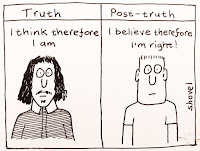
People use to disagree over interpretations of facts. Now people have different facts. People create their own “alternative facts” that confirm their beliefs. Evidence be damned. It doesn’t matter what really happened. All that matters is what we believe happened. Truth is in the mind of the beholder.

I can’t help but think of Pontius Pilate interrogating Jesus. Jesus said to him, “For this reason I was born and have come into the world, to testify to the truth. Everyone who belongs to the truth listens to my voice.” Pilate responded, “What is truth?” I imagine Pilate throwing up his hands in exasperation as he said those words. It sounds strangely modern or - to be more precise - post-modern.

As a young evangelical in the 1970’s and 80’s I used to warn my parishioners of the dangers of a society drifting into relativism. People talked about what is “true for me” and “true for you.” I predicted that without any common standard of truth, society would fall apart. My prophecy has come true … so to speak.

The scientific method used to be accepted as a discipline to arrive at facts. Now we live in an age of science denial. Doctors used to be respected. Now they are suspected … of trying to kill us and our children with vaccines and masks. Journalists used to be viewed as independent investigators who uncovered truth. Now journalists are vilified as propagandists spreading lies.

We live in a post-truth era. People no longer even search for truth. They think it is a lost cause. If we found it, no one would believe it anyway. So why even try? How would people even know if they found it? Disinformation and misinformation are so rampant that people can no longer distinguish fact from fantasy. They have not been trained how to reason, so they will believe anything. Even the concept of “fact” seems quaint. There is only “us versus them.” Information is ammunition.

For me as a pastor this attitude is particularly troubling within Christianity. I went to the Southern Baptist Theological Seminary in Kentucky back when Baptists were in the mainstream of biblical and theological scholarship. Science was considered a gift of God. History was seen as the arena of God. To deny science or history was to deny God. The gold standard for biblical studies in my seminary was the historical critical method. My professors sought to recover actual historical events from beneath the layers of literary traditions in the Bible.

Then the fundamentalists took over the denomination and the seminary. Historical science was abandoned in favor of doctrinal purity. The Bible was announced to be inerrant in all matters, including history and science. The universe was created in six days six thousand years ago. Adam and Eve were declared to be real persons. The Garden of Eden was a real place, complete with a real talking snake. Noah’s Flood really happened.  Methuselah lived to be 969 years old. The sun stood still for nearly a day in order to give Joshua time to take revenge on the Amorites. Sarah gave birth at age 90.

To think otherwise is the devil’s lie, they say. That is why Southern Baptists and other evangelicals have embraced post-truth politics so readily. They have lived in fantasyland for a hundred years, since fundamentalism was formed in response to modernism in the 1920’s.

In the name of God they have fought against historical and scientific truth. They have insisted on interpreting biblical stories literally and rejected any historical and scientific evidence to the contrary. They have fought against evolution. They have championed creationism, intelligent design, prayer and Bible reading in schools. They are very used to distrusting scientists and historians.

They have built temples to their literalism, such as the Creation Museum and Noah’s Ark in Kentucky. They have led the way in creating their own set of “facts.” Anything that does not conform to their worldview is nonfactual. They have constructed an alternate reality, complete with Christian schools and home schooling curriculum to perpetuate it.

These anti-science, anti-history Christians were ripe for the picking by the conspiracy theorists, anti-vaxxers and political operatives who recruited them. It is one thing to have an evangelical subculture as an alternative to mainstream culture. It is another thing to try to remake American culture in that image.  Yet that is what is happening today. Democracy is of no value to those who see theocracy as God’s perfect will for planet earth. Like God in the Book of Revelation, they are willing to burn down the house to bring it about.

No longer is the old hymn “Onward Christian Soldiers” just a metaphor. Now Christian culture warriors buy semi-automatic weapons, wear camo, and form militias in the name of Jesus. Among the conspiracists who stormed the Capitol on January 6 were evangelicals, who waved flags that proclaimed "Jesus is my Savior, Trump is my President," "Jesus saves," and "Jesus 2020."

After seizing the Capitol building they offered a prayer to Jesus from the podium of the Senate chamber, “Jesus Christ, we invoke your name!” All the people responded “Amen!” These are the new Christian Crusaders. As a Christian shaped by Enlightenment and democratic values, this feels like a return to the Dark Ages. God help us all. 

Sunday, December 19, 2021

The Essence of Christmas

What is the essence of Christmas? Most Christians would not hesitate to say it is the birth of Jesus, but surely Christmas is more than a religious birthday party. Those of non-Christian religious traditions look to the winter solstice for inspiration. They find spiritual significance in the change of seasons and the symbolism of light and darkness. Those of a secular mindset use the time to celebrate family, friends, food, community, and generosity.

I embrace all these facets of the season. I love that this solstice celebration has roots more ancient than Christianity. I do not begrudge the secularization of the holiday. I love the fact that Christmas has expanded beyond the Church. 

I even like Santa! I am not a culture warrior who promotes the use of the slogan “Merry Christmas” as a means to thumb my nose at those who do not share my religious beliefs. Such mean-spiritedness is a violation of the Christmas spirit.

As a Christian theologian I look to the gospel birth narratives for the reason for the season. As a practitioner of the historical-critical method, I am aware of the problems associated with taking these accounts as history. Yet the symbolism of the ancient stories is powerful. It never fails to fill me with awe every year. 

So what is the meaning of the season? It is transcendence. This is what the heavenly host and nativity star point to. There is a Reality beyond the mundane interpretations of human existence. Heaven and earth meet at Christmas.

It is beauty. Most people do not think of the Battle Hymn of the Republic as a Christmas carol, but it is. “In the beauty of the lilies Christ was born across the sea / With a glory in his bosom that transfigures you and me.” Christmas is about transfiguration. I experience this every Christmas Eve as I sing Silent Night.

It is about immanence and incarnation. The Christmas story is very earthy. It is about pregnancy and childbirth in difficult circumstances. It is shepherds reeking of sheep and goats, kneeling before a newborn child, who has been laid in a feeding trough in a stable. I have often thought that only those who practice animal husbandry can really appreciate what Christmas is all about.

Most of all it is about mystery. Its meaning is beyond our knowing. It is about unknowing what we think we know. If we think Christmas is a rallying point for our team in opposition to other religious teams, then we have missed the point of the Wise Men coming to honor the Christ Child.

The Magi were likely Zoroastrian priests from Persia or possibly Nabateans from Arabia. Christmas is about a Spiritual Reality that cannot be contained within the confines of one religion. It is about the One who transcends religious differences, yet inspires them all.

The essence of Christmas? It is found deep within the human heart. Jesus taught, “The Kingdom of God is within you.” It is found in the hearts of other animals as well, hence the prominent place that nonhuman creatures play in biblical narratives and later Christmas traditions. That accounts for the popular image of the Peaceable Kingdom at Christmastime.

It is found in the heavens, which is the meaning of the Star of Bethlehem. It is found in children. The focus of Christmas is a newborn child. The Child of Bethlehem grew to be the Rabbi of Nazareth who said, “One must become like a little child to enter the Kingdom of God.”

Jesus also taught, “Love your neighbor as yourself.” According to Jesus “neighbor” included Samaritans (who were considered heretics) and enemies. If you want to find the essence of Christmas, look to unconditional love - a love that conquers our fear of people who look and worship differently than us.

Look within the heart of your Jewish neighbor, Muslim neighbor, Hindu neighbor, Buddhist neighbor and Sikh neighbor. That is where Christmas is found. Look to Love that transcends religious boundaries. As the hymn says, “Love came down at Christmas.” That is the essence of Christmas.

“Fear not: for, behold, I bring you good tidings of great joy, which shall be to all people…. Glory to God in the highest and on earth peace, goodwill toward all!” 

Monday, December 13, 2021

Born in Us

Thirty years ago on this date I was in Bethlehem. Our whole family lived just outside of Bethlehem for the fall semester while I studied at the Tantur Ecumenical Institute. We could view the town of Bethlehem from the balcony of our apartment. Those were the days before a wall and a military checkpoint separated the West Bank from Israel. We used to walk freely into Bethlehem as a family regularly. I spent many hours at the Basilica of the Nativity, which is the traditional site of Jesus’ birth.

For that reason I get a bit nostalgic whenever I sing the Christmas carol “O Little Town of Bethlehem.” The hymn was written in 1867 by Phillips Brooks, an Episcopal pastor from Philadelphia. He had been in Israel two years earlier and had celebrated Christmas in Bethlehem. One phrase in the final stanza is particularly meaningful to me. It is a prayer to the Holy Child of Bethlehem to “be born in us today.” This is the meaning of Christmas.

Christmas is not just a birthday celebration. If that were the primary purpose of Christmas then the Bible would give a date for Jesus’ birth. It doesn’t. The mention of the Roman census does not help historians narrow it down. Christmas is not really about angels, shepherds, wise men, or a miraculous star in the East. These are symbolic elements meant to point the reader to a deeper spiritual reality.

They point to the truth that Christ is born in us. That is why the figure of Mary is so important in Luke’s nativity account. Christ was born in her. This is more than physical pregnancy. It is about spiritual pregnancy. It points to spiritual truth. Christ was born in her.  Christ is born in us. As the hymn says, “O Holy Child of Bethlehem … be born in us today.”

To use the theological term, Christmas is about incarnation. God enfleshed. God was in the human named Jesus of Nazareth. Jesus learned this himself at his baptism when he heard the heavenly voice calling him a beloved son. The apostle Paul extended it to us: “You are all sons of God through faith in Christ Jesus. For all of you who were baptized into Christ have clothed yourselves with Christ.”

Christmas is about the spiritual reality at the heart of human existence. It is about a spiritual transformation that can happen to all of us.

How silently, how silently,
the wondrous gift is given!
So God imparts to human hearts
the blessings of his heaven.

It is about knowing our true nature as children of God. It is about claiming this birthright. Christmas is not just about a humble birth in the little town of Bethlehem two thousand years ago. It is about the birth of the eternal Christ in us today.

We hear the Christmas angels
the great glad tidings tell;
O come to us, abide with us,
our Lord Immanuel!

Thursday, December 9, 2021

Courage as a Spiritual Practice

In response to my previous post “Civil Courage,” a long-time minister friend replied, “How is the ordinary citizen or Christian to act with courage? Tell us how and when and where. We want to be courageous…but how?” Here’s my answer. Once again I will look to Dietrich Bonhoeffer for my inspiration. Courage is a spiritual discipline to be exercised like any other spiritual practice. So how do we practice courage?

First, Pay the Price. There is a cost for courage. Dietrich Bonhoeffer wrote in The Cost of Discipleship “When Christ calls a man, he bids him come and die.” This does not necessarily mean martyrdom like Bonhoeffer suffered. It can be enduring the verbal assaults so common these days. “Blessed are you when they insult you, persecute you, and say all kinds of evil against you falsely, for my sake,” proclaimed Jesus. He said, “Whoever wants to be my disciple must deny themselves and take up their cross and follow me.”

This practice of laying down one’s self is a core spiritual discipline. Ultimately the spiritual life is all about selflessness. It is dying to self and living to God. Being willing to surrender the ego to the crucible of criticism is a great boon to this process. It purifies our motives. Our enemies are our greatest allies in this spiritual process. 

Being willing to suffer for God’s sake is the price of courage. Being willing to stand with those who suffer is the price of spiritual liberation.  "Our God is a suffering God," wrote Bonhoeffer. "Man is summoned to share in God's suffering at the hands of a godless world."

Second, Speak Out! Prophesy! Bonhoeffer wrote: “Silence in the face of evil is itself evil: God will not hold us guiltless. Not to speak is to speak. Not to act is to act.” Two days into Hitler's reign Bonhoeffer delivered a radio address critical of the new chancellor. He warned Germans that this personality cult would lead to the eradication of their freedoms. He labeled the strutting Fuhrer a Verfuhrer – “misleader.” His microphone was cut off before he finished.

Third, Act. Courageous action is always inconvenient, but it is absolutely necessary that courage be expressed in deeds and not just in words. “We must be ready to allow ourselves to be interrupted by God,” Bonhoeffer wrote. He served as a member of the Abwehr, the German Military Intelligence Office, where he acted as a double agent for those opposing the Nazi regime. He taught at the underground seminary of Finkenwalde. He acted. He said, “One act of obedience is better than one hundred sermons.”

He agonized over his decision to be part of the plot to assassinate Hitler. He reasoned, “If I sit next to a madman as he drives a car into a group of innocent bystanders, I can't, as a Christian, simply wait for the catastrophe, then comfort the wounded and bury the dead. I must try to wrestle the steering wheel out of the hands of the driver.” He said, “We are not to simply bandage the wounds of victims beneath the wheels of injustice, we are to drive a spoke into the wheel itself.”

Fourth, Give. In our society, funding causes is an effective form of action. Use “unrighteous mammon” for good, as Jesus advised. There are many causes to choose from: courageous journalism, supporting refugees, and contributing to brave politicians who are paying the price for courage. Among others I am donating to Faithful America, an online Christian community that is “organizing the faithful to challenge Christian nationalism and white supremacy and to renew the church's prophetic role in building a more free and just society.” Jesus said, “Where your treasure is there your heart will be also.”

Fifth, Love. In The Cost of Discipleship, Bonhoeffer wrote: “The will of God, to which the law gives expression, is that men should defeat their enemies by loving them.” “Christian love draws no distinction between one enemy and another, except that the more bitter our enemy’s hatred, the greater his need of love. Be his enmity political or religious, he has nothing to expect from a follower of Jesus but unqualified love. In such love there is no inner discord between private person and official capacity. In both we are disciples of Christ, or we are not Christians at all.”

In our angry, hate-filled political environment, it is most important that the heart of spiritual courage be love. Love for those who suffer. Love for neighbor. Love for enemy. Without love we might win a political battle, but we lose the spiritual war. It is of no use to win an election and lose one’s soul. When our critics spew venom, we are to respond with the grace of Christ. This is the most difficult, but the most important part of the spiritual discipline of courage.