TO GO TO THE NEW HOME OF SPIRITUAL REFLECTIONS PLEASE CLICK ON THE IMAGE

SPIRITUAL REFLECTIONS HAS MOVED!

This blog has moved to Substack. To go to the new site please click on the image above

Tuesday, March 29, 2022

Compassionate Resistance

Regular readers of this blog know that I try to balance Christian spirituality and social activism. In my podcast and YouTube channel I focus chiefly on the spiritual dimension. I use the phrase “Christian nonduality” to describe my approach. I explore the mystical dimension of Christianity and other faiths. In my blog I often tackle the political and social issues. Inevitably the two areas intermingle.

Recently I received an unexpected email from Rev. Dr. Christopher Schelin, Dean of Students at Starr King School for the Ministry in Oakland, California. Starr King is a Unitarian Universalist seminary, a member of the Graduate Theological Union, affiliated with the University of California, Berkeley. Dr. Schelin also holds the positions of Director of Contextual Education and Assistant Professor of Practical and Political Theologies.

He wrote to inform me that he had written a research paper entitled “Compassionate Resistance: Opposing Trumpism in the Nondual Political Theology of Marshall Davis.”  This month he presented it to the Annual Meeting of the Western Region American Academy of Religion. For those who are interested in reading the paper, it can be found at academia.edu.

I was surprised – but pleased - at his announcement. Even though I had corresponded with him previously, I did not know he was researching my work. I certainly did not consider my work worthy of an academic paper. Furthermore I have never thought of myself as a political theologian. Yet … come to think of it … of course I have a political theology! All people who intentionally seek to live out their faith in the public arena are political theologians! Mine just happens to be more public than most.

First of all, Dr. Schelin did an excellent job in his research. He understands my approach better than most people, who know only bits and pieces of my writings. I also like his choice of the term “compassionate resistance” to describe my approach.  I have compassion toward those who disagree with me on political and social issues. I try to enter into the hearts and minds of those who hold views different than my own.

The key factor of this approach is the spiritual teaching to love one’s enemies. That is the essence of both the Apostle Paul’s and the Lord Jesus’ social engagement. This is what is missing in secular politics, especially the extremist forms gaining popularity today. Both the Right and the Left are afraid that listening to and understanding their enemies will undermine their position. Without someone to fear and hate, they think the motivation for their position will dissipate.

Fear and anger are the twin engines of politics these days. They are sources of disinformation and misinformation. One must demonize one’s enemy in order to justify them being enemies. If we turn our enemies into devils, it is easier to justify our own cause as righteous. So the facts become distorted in order to confirm our fears. In time we start to believe our own rhetoric.

The truth is that our enemy is more like us than we wish to believe. Enemies are mirror images of ourselves. They are us. As the comic sage Pogo famously said, “We have met the enemy and he is us.” That is why we fear them. That is why they stir such anger in us. They expose our true selves. There is nothing we hate more than seeing what we really are. We will do almost anything to prevent ourselves from acknowledging that painful truth.

When we love our enemies, we recognize our enemies as neighbors. Jesus taught us to love our neighbors as ourselves. We love our neighbors when we realize that at a deep level they are ourselves. We are one. Jesus said that the commandment to love our neighbor is “like unto” the command to love God. When we love our enemies we see God in them.

Loving our enemies tears down the “dividing wall of hostility.” That is how the apostle Paul described Jesus’ sacrificial love. Love destroys our enemies by turning them into brothers and sisters. As Abraham Lincoln said, “The best way to destroy an enemy is to make him a friend.”

This does not mean that we give up on the political process. It means that we engage in political thinking and action out of compassion and love - not from fear and anger. We do it from a position of unity rather than division. We are one. As a country we are the United States of America. When we forget the “united” part, we have lost before we begin. When we keep the union front and center, all things are possible.  That is nondual Christian politics. That is compassionate resistance.

Sunday, March 20, 2022

Beyond the Culture Wars

I struggle with how to address today’s culture wars from a spiritual perspective. These political movements use the language of religion, morality, family and patriotism. For that reason it is difficult to address them from a spiritual perspective. When I use spiritual language to warn about the dangers of such movements, my words sound like I am part of the culture war.  

The truth is I am not interested in fighting the culture wars. My loyalties are not to parties, leaders, or ideologies. My loyalty is to the Peaceable Kingdom. I can see the Kingdom of God from where I stand. I stand in it. It is here now, and it is breaking into history for those with eyes to see. I endeavor to speak from a Kingdom perspective.

At times I speak in the language of the biblical prophets. “What does the Lord require of you? To act justly, and to love mercy and to walk humbly with your God!" At other times I use the language of the mystics, speaking of union with God. At such times it is tempting to remain neutral, to abide in a lofty spiritual realm that transcends earthly battles.

Yet biblical spirituality does not allow for that option. The prophetic witness of scripture will not let me. To remain neutral when evil surges is to side with evil. As Martin King said, “He who passively accepts evil is as much involved in it as he who helps to perpetrate it. He who accepts evil without protesting against it is really cooperating with it.”

Jesus spoke out against the collusion of “church and state” and was tried for treason in the culture wars of his time. At his trial Jesus declared, “My Kingdom is not of this world. If it were, my servants would fight to keep me from being handed over…. But my Kingdom is not of this world.” I choose Christ’s Kingdom over the worldly kingdoms. The Kingdom of God is not the possession of any nation, religion or political party.

From the Kingdom of God I watch earthy kingdoms rise and fall. There will always be wars and rumors of wars. There will be always be earthquakes, fires, floods, and natural disasters. Jesus said the poor will always be with us. Scripture says there are antichrists and false prophets in every age.

Human history is a play of good and evil, light and dark, right and wrong, yin and yang. It has always been this way. As actors in this drama of history we play our roles. We work for good against evil – as we understand them – always realizing that we see through a glass darkly. We might be wrong, yet we must persevere nonetheless. To do any less is to surrender to fatalism.

In the midst of it all we remember that our citizenship is in heaven. We are children of God. The flesh is temporary, but the Spirit is eternal. It is important to keep an eternal perspective on temporal matters. The great causes of our day will be forgotten. When the earth is swallowed by our dying sun and humankind is a distant memory in the mind of God, it will not matter if Republicans or Democrats prevailed in 21st century America.

I will still speak out, vote, contribute to causes, and protest in the streets when necessary. I will write, blog, podcast and record videos. As I do, I will keep my eyes focused on the Kingdom of God. I will not trust in leaders, armies or political parties. I will not trust ideology. I will trust the God who is beyond my human understanding. As the apostle Paul says:

“For, as I have often told you before and now tell you again even with tears, many live as enemies of the cross of Christ. Their destiny is destruction, their god is their stomach, and their glory is in their shame. Their mind is set on earthly things. But our citizenship is in heaven. And we eagerly await a Savior from there, the Lord Jesus Christ, who, by the power that enables him to bring everything under his control, will transform our lowly bodies so that they will be like his glorious body.” Amen. 

Wednesday, March 2, 2022

I Am Not Dust

Even though I am a pastor, I am not much for religious rites. I am more interested in the spiritual meaning. Ash Wednesday was always out of my religious comfort zone. That changed during my last year in fulltime ministry when I participated in an ecumenical Ash Wednesday Service.

I told the host pastor I would not be receiving the ashes, but when she offered the option of having ashes placed on our hands rather than on our foreheads I changed my mind. That felt safe enough for this old Baptist preacher. Now I love Ash Wednesday and the words, “Remember you are dust and unto dust you shall return.”

Dust is everywhere, especially in these final weeks of winter when our homes are longing for a spring cleaning. I get ashes on me daily as I tend to my woodstove. I scatter sand on our driveway. I track dirt into our entryway. Dust cohabitates our home with us, in spite of our attempts at “dusting.” Dusting just moves the dust around.

Likewise ashes are everywhere. They are piled in the ash bucket next to the woodstove in our living room. They coat my eyeglasses. Daily I find soot on my hands, arms and clothing. Sometimes I feel like Job “covered in dust and ashes.” The omnipresence of dust and ashes make them excellent symbols for the omnipresent God.

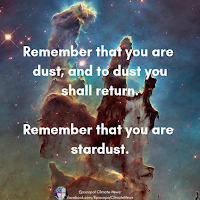
Dust is also an apt metaphor for our human nature. Our bodies are made of dust. Carl Sagan called it stardust. God told Adam in Genesis that one day our bodies will return to dust. “Ashes to ashes, dust to dust,” as the burial ritual says. That truth was made real while I was writing this post and got news that a friend and colleague in active ministry here in New Hampshire died suddenly while returning from vacation.

Contemplating our mortality points us to the immortal. Contemplating our material nature points us to our spiritual nature. Having my face smudged with ash points me to my True Face, which is not made in the image of my simian ancestors but made in the image of God.

A Zen koan says, "Show me your original face before you were born.” My ashy face points me to my unborn face. Ashes remind me of the inevitable dissolution of my physical form, which leaves only the unformed, which is my true nature. There is a poem I have often read at graveside services. It reads in part:

I am the thousand winds that blow
I am the diamond glints in snow
I am the sunlight on ripened grain,
I am the gentle, autumn rain.
As you awake with morning’s hush,
I am the swift, up-flinging rush
Of quiet birds in circling flight,
I am the day transcending night.

The refrain “I am” reminds me what I am. Jesus called himself the “I am” that precedes all predicates.  Jesus was pointing his hearers to the Divine Nature that was revealed to Moses in the burning bush. The bush on Sinai burned but did not turn to ashes. “I AM” is indestructible. “I AM” is in the body and beyond the grave. “I AM” is in human forms and beyond form.

Tonight I will be attending a contemplative Ash Wednesday service. When the pastor places ashes on my forehead and intones “Remember you are dust and unto dust you shall return,” I will remember that though this body is dust, I am not this dusty frame. I do not have to return anywhere. I am here now. I remember who I am. I am what I was before I was born and after I die. So are you. Remember.

Monday, February 21, 2022

On Being Quaint

I have been called a lot of things during my career as an ordained clergyman, but until this week I have never been called quaint. I feel like I have been labeled a hobbit. A new book published last week by Glenn Packiam uses the word “quaint” to describe clergy.

In his book entitled The Resilient Pastor, the Barna senior fellow examines the newest surveys and confirms what pastors already know — that ministers are not as respected and influential in American society as we used to be. In summarizing his findings Packiam writes: “Pastors, for the most part, are peripheral and ornamental. Quaint, but not entirely necessary. Kind, but not wholly credible.”

Ouch! That hurts! Especially that “ornamental” part. It sounds like irrelevancy. Clergy do not want to be thought of as irrelevant. But, alas, I think he is speaking the truth, which is why it hurts. Most people in today’s society view clergy as anachronisms. They are “quaint,” like a country cottage or a New England white clapboard church. It doesn’t help that I live in in the country and served such a church!

One interesting aspect of the research is that clergy concur with the study’s findings. We are aware of the trend, and we are part of it. Pastors do not find their fellow clergy as trustworthy as they used to be. I find clergy increasingly unreliable in many areas: science, history, politics, sexuality, ethics, and even spirituality. Many seem vulnerable to conspiracy theories.

Part of the problem is the lack of education. Many pastors these days lack a basic undergraduate liberal arts education, much less a graduate theological education. Consequently many pastors are unknowledgeable of science and history, as well as biblical and theological scholarship. Not trained to think critically, these pastors follow the trends of popular evangelical culture and its celebrity pastors.

Even seminary-trained clergy have seen the writing on the church wall. They know that to be “successful” they need to play the game. They have to give the people in the pews what they want. Increasingly church folk want what they hear on Christian radio, television, and online. I find such clergy “not wholly credible,” to use Packiam’s phrase.

Now about the “quaint” label. As I think about it, perhaps I am quaint. If so, I am okay with that. Quaint is defined as “unusual or different in character or appearance.” Synonyms are “unusual, bizarre, eccentric, curious, peculiar, queer, odd, whimsical, strange, and outlandish.” I am okay with all those designations. I will wear the slur of quaint as a badge of honor.

Even “peripheral” is not such a bad term. Jesus was on the periphery of the religion of this day. He hung out with the people on the margins of society, yet his influence was not marginal. Seeking to follow my Lord, I am definitely on the periphery of today’s Christianity. Does that make me “peripheral?” If so, I am glad. I would not have it any other way.

I am connecting with a wider range of people now than I ever did when I was in mainstream ministry as a fulltime pastor. I reach more people with my books, podcasts and videos than I did with my weekly in-person sermons and Bible Studies. So call me quaint. Call me peripheral. Call me “unusual, bizarre, eccentric, curious, peculiar, queer, odd, whimsical, strange, and outlandish.” But please don’t call me ornamental.

Tuesday, February 15, 2022

A Christian Reads the Gita

Recently my daily devotions have included reading a chapter from the Indian spiritual classic the Bhagavad Gita. Each morning I read a chapter from the Hebrew prophets (I am presently reading Isaiah), a section from Thich Nhat Hanh’s Living Buddha, Living Christ, and then a chapter from the Gita.

The Bhagavad Gita is probably the most famous Hindu scripture, written about the same time as the Hebrew Torah was being finalized.  I first came in contact with it while in college. I was offered a copy of The Bhagavad-Gītā As It Is by a shaved head, chanting, dancing devotee of the Hare Krishna movement who was visiting campus. I read it and kept it for years.

I studied the Gita again in seminary while studying the world’s religions, but I have not read it since. I thought it was about time to buy a new translation and explore it again. This time I purchased Stephen Mitchell’s new translation. His edition of the Tao Te Ching is my favorite, so I was eager to see how he approached this beloved Indian scripture.

I have been surprised at how this reading of the Bhagavad Gita has affected me. Although I do not resonate with it as much as the Upanishads, which have been very influential in my spiritual life, I find it is helping me work through a moral dilemma that I am struggling with at this time.

For those of you unfamiliar with the Bhagavad Gita, it is a conversation between the Indian warrior Arjuna and his charioteer, who is actually Krishna, an incarnation of God. Arjuna is about to go into battle against some of his kinsmen when he has crisis of conscience. He cannot bring himself to fight and kill people that he knows. He decides to lay down his bow and become the ancient equivalent of a conscientious objector.

At that point Krishna starts up a dialogue with Arjuna, attempting to persuade him to fulfill his duty as a member of the warrior caste and fight. This conversation is the substance of the Gita, which itself is part of the larger epic the Mahabharata. During the conversation Krishna explains various ways that one comes to know God. He speaks about the true nature of Reality, God and human beings.

These topics are interesting, but it was the subject of war that got me thinking the most. This has been a struggle in my life ever since the Vietnam War. Over the years my approach has fluctuated between an ethic of nonviolence and just war theory. I consider the major American wars during my lifetime – Vietnam, Iraq and Afghanistan – to have been unnecessary and costly in human lives and suffering. I opposed them all. But I cannot rule out the possible need for military action when the situation requires it.

I consider the United States to be at a crossroads at the present time. For the first time in my lifetime American democracy is being threatened by a domestic enemy. The January 6 attack on the US Capitol building was just the opening salvo. Christian nationalism and the right-wing anti-democracy movement are gaining strength. It is working at the local, state and national levels to rig elections, censor books and roll back basic rights.

There is a large portion of lawmakers and the American population who are willing to dismantle our two-century-long experiment in democracy in order to advance their political, religious, and social agenda. So far it has not resulted in widespread violence, but I can see where it could end in armed conflict if this trend is not reversed.

I have been contemplating how far mainstream Christians should go in defending our democracy against these anti-democracy forces. I have not come to a decision. Part of me wants to follow in the footsteps of Martin Luther King and Mahatma Gandhi. Another part of me wants to exercise my second amendment right. Do I practice nonviolent resistance or do I use force to stop fascism before it gets too powerful?

Last year I penned several blog posts about Dietrich Bonhoeffer, a theologian who was faced with a similar dilemma in Germany during the 1930’s and 40’s. He ended up working as a double agent in German intelligence and becoming part of the plot to assassinate Hitler. He was executed by the Third Reich for his choice. I admire his Christian faith and his courage.

In a recent radio/podcast interview on The Meetinghouse, my friend Dwight Moody and I talked about the threat of Christian Nationalism and how it is affecting churches and pastors. We both agreed that this was not the time for clergy to keep silent about these threats to American freedoms. But what more can we do than just talk? I think we can learn from the example of the 20th century Civil Rights and Anti-War movements.

At the end of the Gita Arjuna is persuaded by Krishna to fight in the upcoming battle. In chapter after chapter of the Book of Isaiah, God declares war for his divine purpose. Yet Isaiah also has the most beautiful images of the peaceable kingdom in the Bible. For a Christian the ethic of Christ supersedes the Old Testament ethic. Jesus said, “You have heard that it was said of old, but I say unto you…..” In the same spirit Gandhi concluded, “The Gita does not decide for us.”

Reading the Bhagavad Gita has been a way for me to have an internal debate about how far a follower of Jesus can engage in earthly battles. For now my pacifist roots are prevailing. Nonviolence seems like the only long-term solution. Violence sows the seeds of future violence. An eye for an eye and a tooth for a tooth only makes the whole world blind and toothless.  And my dentist says I have no teeth to spare. Yet if the redcaps try to do to my house what they did to the People’s House, I am not making any promises. 

Wednesday, February 9, 2022

Unforgivable

According to Jesus there is a sin that can never be forgiven. As a child my wife thought the unforgivable sin was calling someone a fool. Her childhood fear was based on the Sermon on the Mount, where Jesus says, “Whoever says, ‘You fool!’ shall be liable to the hell of fire.” That is a pretty heavy load for a child to carry!

An unforgivable sin is mentioned in Mark’s gospel where Jesus says, “Truly, I say to you, all sins will be forgiven the sons of men, and whatever blasphemies they utter; but whoever blasphemes against the Holy Spirit never has forgiveness, but is guilty of an eternal sin.”

Matthew’s version expands upon it a bit. “Therefore I tell you, every sin and blasphemy will be forgiven men, but the blasphemy against the Spirit will not be forgiven. And whoever says a word against the Son of man will be forgiven; but whoever speaks against the Holy Spirit will not be forgiven, either in this age or in the age to come.”

It is interesting that the “unforgivable sin” is not some blatantly immoral act like genocide, torture, child abuse or voting for Donald Trump. It is not something one does; it is something one says. Yet it is not thoughtlessly saying “You fool!” in the heat of the moment. It is speaking against the Spirit because one’s heart is set against the Spirit. Words are a window into the heart.  As Jesus said, “Out of the overflow of the heart the mouth speaks.”

The context of Jesus’ pronouncement of an “unforgivable sin” is important. The statement is given during an altercation between Jesus and some Pharisees. These devout, religious believers were telling people that Jesus’ ministry was not inspired by the Spirit of God but by Beelzebul, the prince of demons. In other words they were saying that Jesus was Satanic.

These Pharisees were so indoctrinated that they were unable to recognize the Spirit of God in someone who was not part of their religious group. Not only that, but they believed that anyone of a contrary religious persuasion was evil. They labeled the work of the Spirit as demonic.

They could no longer tell the difference between good and evil. As the prophet Isaiah warned, “Woe unto them that call evil good, and good evil!” The Christian version of the unforgivable sin is not recognizing the Spirit of God in other faith traditions. Some Christians go so far as to repeat the sin of the Pharisees, labelling other religions demonic.

If we cannot recognize the Holy Spirit in the Buddhists like Thich Nhat Hanh, then we do not know the Spirit who was in Christ. If we do not see the Holy Spirit in the Hindus like Ramana Maharshi, we do not know the Spirit of Jesus. If we do not hear the Holy Spirit in the words of the Muslims like Rumi, we cannot hear God’s Word anywhere.

That does not mean that all religions and religious leaders are equal. Some faiths and faith leaders are more transparent to the Spirit than others. Some are clean windows through which the Spirit shines. Others are windows obfuscated by dogma, tradition, and legalism.  But wash away the grime and you can glimpse the omnipresent Spirit behind all windows.

To be unable to recognize Jesus when he walks the Emmaus Road with us in the form of a person of another faith is spiritual blindness. But is this unforgivable? That assessment sounds like a “spiritually correct” form of exclusivism and intolerance, until we see it is not a matter of whether God forgives; it is a matter of whether we are open to forgiveness. If we are blind to our own blindness, then we see no need for forgiveness. That is the definition of unforgivable.

For some Christians, acknowledging that God is present in other faiths is considered the unforgivable sin. It is thought to be a betrayal of the Christian gospel. It feels to them like a denial of Jesus. It feels like apostasy or heresy. It feels like unbelief, which some consider to be the unforgivable sin. With their eyes and ears firmly clenched, they cannot discern the presence of God.

But is this unforgivable? The God I know is Unconditional Love. Nothing is unforgivable for Love except unforgiveness, as Jesus taught in the Lord’s Prayer. Jesus prayed, “Forgive us our trespasses as we forgive those who trespass against us.” He went on to explain, “If you do not forgive people their trespasses, neither will your Father forgive your trespasses.” We receive forgiveness to the extent that we forgive. Unable to forgive, we are unable to accept forgiveness.

Are we willing to forgive those who will not accept our religion? Are we willing to forgive those who do not understand God the way we do? Are we willing to accept them as spiritual sisters and brothers? Are we willing to forgive ourselves for our religious arrogance? Are we willing to forgive God for transcending our religion and welcoming people of all faiths? If so, nothing is unforgivable.

Wednesday, February 2, 2022

The Closing of the American Heart

The worst part of the present political discord in the United States is what it is doing to Americans’ hearts. There is no longer room in our hearts for others, whether those “others” are members of the opposing political party, persons of other races, other religions, or other sexual orientation. To modify the title of Allan Bloom’s bestseller (The Closing of the American Mind) slightly, this is the closing of the American heart. Doctor Seuss said of the Grinch:

Now, please don't ask why. No one quite knows the reason.
It could be his head wasn't screwed on just right.
It could be, perhaps, that his shoes were too tight.
But I think that the most likely reason of all
May have been that his heart was two sizes too small.

I do not rule out the head or shoe theories when it comes to what is happening to Americans, but it seems to me that our hearts are shrinking. To use a biblical metaphor, our hearts are becoming hardened. According to Christ this is a dangerous spiritual condition. Hardheartedness is more contagious than any coronavirus. No mask or vaccine can prevent it.

We contract it from our adversaries. (It is no coincidence that the word “contract” also means to shrink.) When we hear disinformation and propaganda, lies and hate, it conjures anger within us. Our hearts contract. We tend to meet anger with anger. This is the emotional equivalent of “an eye for an eye.” As Gandhi said, this only makes the whole world blind. Jesus called this reciprocity the spiritual equivalent of murder.

Christ’s assessment should give us pause to think about how serious our current situation is. Yet we usually don’t stop to think. We are too busy reacting. We are too busy fighting to notice what the fight is doing to us. The excuses we make for ourselves are the most dangerous aspect of the problem. We have shrouded the struggle in the clothing of self-righteousness and patriotism. We believe our own rhetoric.

What can we do about this spiritual plague that is sweeping through our land? The biblical book of Proverbs says: “Above all else, guard your heart, for everything you do flows from it. Keep your mouth free of perversity; keep corrupt talk far from your lips. Let your eyes look straight ahead; fix your gaze directly before you. Give careful thought to the paths for your feet and be steadfast in all your ways.”

This sounds to me like the spiritual practice of mindfulness! The root problem of today is mindlessness. We are not mindful of what we are feeling or thinking or saying. We are unaware of how we come across, how we are heard. Most of all, we are unaware of what the toxic political environment is doing to our hearts, how we are being changed inwardly. 

There is spiritual climate change happening in our country. There is wholesale devastation of our spiritual environment, and people are unaware of it. People are concerned about environmental pollution but not spiritual pollution. We are so intent on saving America that we may be losing our souls in the process. As Jesus said, “For what shall it profit a man, if he shall gain the whole world, and lose his own soul? Or what shall a man give in exchange for his soul?”

What good is a soulless America? Yet we are headed in that direction. The churches are not helping. Some churches are part of the problem rather than the solution. Some preachers are the worst offenders. Others are just watching it happen, conducting business as usual.  This will be the death of us as a nation, and it will be the death of American Christianity.

The fact that this spiritual hardening is happening at the same time as a precipitous decline in church attendance is not accidental. Many Christians believe that the decline in church attendance is the result of our society’s rejection of Christianity. We blame a godless and secular society for church decline. But the problem may be closer to home. We Christians might be the problem.

The churches may be contributing to the spiritual and moral decline. The abandonment of genuine spirituality by the churches may be causing people to abandon Christianity. When churches forsake God for politics, then people forsake the churches. When religion becomes toxic, then people look for healthier alternatives.

Whatever the cause of church decline, there is a serious spiritual problem in America today. I believe the solution begins with our hearts. We must become mindful of what is going on in our hearts. Notice what today’s poisonous polemics are doing to your soul. Being aware of the problem is half the battle.

When we are aware, then we can put a little space between others’ actions and our reactions, between others’ emotions and our emotions. Put a little space between your thoughts and your words. In that space between thoughts and words is peace. God dwells in this spacious peace. Abiding in this peace is true spirituality.

Jesus said, “Out of the overflow of the heart, the mouth speaks.” What do your words and thoughts say about your heart?  Notice what is happening in your heart. Is it contracting or expanding? Are you opening to others or closing to them? Are you including others or excluding them, welcoming others or rejecting them? Protecting yourself or protecting others?

To the degree that we close our hearts to our neighbors – and our enemies - is the degree that we close our hearts to God. That is what Jesus taught. “As you do to the least of my brothers and sisters, so you have done to me.” Take a moment to be mindful of your heart. It may save your soul … and our nation.