TO GO TO THE NEW HOME OF SPIRITUAL REFLECTIONS PLEASE CLICK ON THE IMAGE

SPIRITUAL REFLECTIONS HAS MOVED!

This blog has moved to Substack. To go to the new site please click on the image above
Showing posts with label Marshall Davis. Show all posts

Saturday, February 20, 2010

The "Judge Not" Juggernaut

 "Judge not, lest ye be judged!" I have had those words thrown at me like a javelin when I have ventured an opinion on some topic of morality. "Let him who is without sin cast the first stone." That is another hardball that is thrown at Christians to shame us into silence.

It doesn't matter that these verses are taken out of context and that other biblical verses calling us to judge correctly are conveniently omitted from consideration. Furthermore, it never seems to dawn on the speakers that they are using those words to judge others. Nevertheless the zingers are still effective in bringing any reasoned discourse to a halt. As the adage says, "When in doubt, shout!"

In his book unChristian: What a New Generation Really Thinks about Christianity... and Why It Matters, David Kinnaman explores the most common attitudes that young people have toward Christians. They are all negative. Two of the top six are that Christians are judgmental and hypocritical. Ouch! Who threw that!

The truth is that it is impossible not to judge. You can no sooner "not judge" than you can have a one-sided coin, breath in and not out, or only eat and not .... Well, you get what I mean.   We live in a world of duality - light and dark, front and back, left and right, good and evil, male and female. You can't have one without the other. It is the nature of existence.

The creation story of Genesis says that as soon as God created light on Day One, he had to separate the light from the darkness. Get it? Without darkness there would be no light! The postmodern phobia about judging just means people don't like being judged. But we don't have a choice.

Revelation 20 pictures a Judgment Day, a heaven and a hell. (Once again, you can't have one without the other.) It is not just those judgmental Christians that believe these things. Every religion of the world from Hinduism to Islam, has some type of judgment after death. Buddhism has layers of hell that makes Dante's Inferno look like a pleasant visit to a sauna.

There is no life without death. We didn't choose to be born, and we cannot choose not to die. We cannot choose not to be judged. Nor can we choose who will be the Judge, any more than a defendant gets to choose who sits on the bench. But we can influence the outcome of the judgment.

You can read the basis for the final Judgment in Revelation 20:11-15. But before you reject this concept as unenlightened, unspiritual or unchristian, let me just say one last word: "Judge not, lest ye be judged!"

Friday, February 19, 2010

Millennium, Smillennium

I have never liked how Christians divide themselves up into factions based on their view of the millennium. On more than one occasion I have been asked the pigeonholing question, "Are you Pre-, Post-, or A-millennial?" For those readers who are eschatologically challenged, that question refers to the timing of Christ's return in relation to the thousand-year reign of Christ mentioned in Revelation 20. (Please don't ask me to explain any further, or I will fall asleep at the keyboard.)

Then the premillennialists further divide themselves into Pre-, Mid-, or Post- tribulation ....zzzz..... (Oh, did I just nod off? Sorry.)

For a while I called myself a pan-millennialist - meaning that it would all "pan out in the end." But that joke got old quickly. Then I tried to expand the options with concepts like quasi-millennial, supra-millennial, or trans-millennial. No one liked my answers. I am obviously not taking the issue seriously enough.

What I really want to do is shout, "IT'S A BOOK OF SYMBOLS, FOR GOODNESS SAKE! DON'T TAKE IT SO LITERALLY!" But then I would be accused of really being a closet amillennialist. A friend recently gave me a disc with twenty lectures that prove the superiority of the amillennial position over premillennial dispensationalism. I was bored after fifteen minutes. So I guess I am not a amillennialist.

I wish more Christians would see symbols as windows to a spiritual reality beyond doctrine. You don't explain things like the millennium; you step through them into the reality that they point toward. It is like the old Zen story about mistaking the finger pointing at the moon for the moon itself. The symbols of Revelation are like Alice's looking glass, a portal to a different world. If you ask me if I am "Pre, Post, or A," then all you are doing is showing me you don't get it.

If John wanted to teach history or theology, he would have written a history or theology book. But he wrote an apocalypse. The closest thing to it today is a "graphic novel." Graphic novels look like comics, but they aren't for kids. They are all about the narrative and the pictures. If someone has to explain them to you, then you have missed the point.

Revelation is spiritual imagination. If you don't have one, then you can always choose between Pre, Post or A.

Tuesday, February 16, 2010

Without a Trace

Archeology has always fascinated me. At one point during my ministry, I subscribed to no less than three different archeological journals! Most interesting to me are the so-called "lost civilizations." It amazes me that whole cities, and even empires, can vanish without a trace. Jungles, deserts and oceans swallow civilizations whole. Empires rise, fall and vanish completely. When the ruins of an unknown metropolis are discovered in some desolate corner of the world, often there are few clues as to the language, culture or fate of the residents.

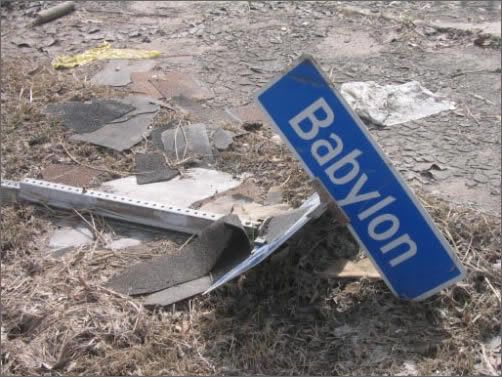
Cultures are fragile and temporary phenomena on this planet. Empires collapse into dust. In Revelation 18 the symbolic city of Babylon burns and crumbles. Its economy is shattered. (18:11-17) Its art and music destroyed. (18:21-24) It becomes nothing more than a ghost town (18:1) and eventually disappears into the sea like the mythical Atlantis (18:21).

So it is with all cities and cultures. So it will be with American culture. It is hard for most of us to fathom this reality. Our country will one day cease to be. This nation has existed for a little over two centuries - a blink of an eye in world history. It is already showing the signs of cultural obsolescence. Likely even the name of the United States of America will be forgotten. Certainly the names of all the politicians, businessmen and entertainers will be lost.

If this is true of nations and civilizations, the powerful and famous, how much more is it true of us? Let me tell you something you may not like to think about. You will be completely forgotten. (Ecclesiastes 2:16; 9:5) No one will remember our names ... not even our own descendants. Can you name any of your great-great grandparents? You have sixteen of them! So is our fate.

All that will remain of us is that which is eternal. If man is truly more than an animal, if we are the intentional creation of God, made in God's image with an immortal, spiritual essence... then that is all that will last.  Therefore the cultivation of the spiritual life is of supreme importance.

Yet our American culture is obsessed with the temporary - temporary fame, temporary prosperity, temporary pleasure, temporary happiness - and the permanent is forgotten. Learn a lesson from Babylon. "The world is passing away, and also its lusts; but the one who does the will of God lives forever." (I John 2:17)

Saturday, February 13, 2010

The God of Disasters

Pat Robertson said that the earthquake in Haiti was a curse from God for a supposed pact that Haitians made with the devil to free them from French occupation. (There was no such pact, but let's not let the facts get in the way of a convenient theodical argument.) Most Christians scoffed and looked down their noses at this televangelist who remains an embarrassment to their religion.

But what alternative explanation did they propose? Was the quake nothing more than a natural phenomenon outside of God's control? If that were true, it would make the Deity into a powerless demigod incapable of controlling what he created.

Was the earthquake simply not important enough for God to prevent? Really? One hundred thousand people die in a minute and it is not worth divine attention? The 2004 Indian Ocean tsunami killed over two hundred thousand. How many people are important enough to get his attention?

The explanation I hear most often is that God "permitted" the earthquake but did not cause it. Does that really get the Lord off the hook? On January 28, a fifteen-year-old girl was severely beaten in a Seattle transit tunnel while three security guards watched and did nothing. They "permitted" the violence, and we are rightly shocked. Is this the type of God Christians believe in? I am as appalled by this type of evangelical deity as I am at Robertson's vengeful cursing god.

The other common solution is to lobotomize God, picturing the Divinity as less than a Person. The Cosmic It is not responsible. It doesn't think or feel. It is just a Force, an impersonal Power, the Energy of the universe. So let's all sing, "We are the World," give a few bucks and feel better. If there is one thing that is obvious to me, it is that God cannot be less personal, conscious or caring than humans are!

So what is the solution? Revelation 16 describes the God of Jesus Christ as "the God behind these disasters" (16:9), referring to the "bowls of wrath" that fill this chapter. In the end the buck stops with God.

I don't have any neat explanation for the age-old problem of suffering and evil. But I know the problem is in our thinking and not in God's nature. It is not that God is inattentive or impotent, callous or uncaring. It is certainly not that God lets the devil do his dirty work while he keeps his hands clean by only "permitting" bad things to happen.

It is that our mini-brains cannot comprehend the Big Picture. All the hand-wringing, name-calling and excuse-making will not change that truth. Somehow the solution centers in the Suffering God, the Lamb slain from the foundation of the world, (Rev. 13:8) the Crucified One who died on the Cross. The more we know Him, the more we understand the pain of the world.

(Artwork is "Haiti will reborn" by Haitian artist Frantz Zephiri)

Friday, February 12, 2010

Sitting By the Dock of the Bay

There is nothing quite like the early morning on a lake. All my life I have spent time each summer on Lake Winnipesaukee in New Hampshire. I often wake up early - preferably at dawn - and go down to the dock and sit. Sometimes I take a canoe or rowboat into the middle of the bay and just sit and absorb the quiet. For me it is an elixir of peace that sinks deep into my soul. I am closest to the heart of God at such times.

The Book of Revelation pictures a sea of glass before the throne of God. (Revelation 4 & 15) The earlier passage pictures the denizens of heaven standing beside the sea, and the latter passage describes the people of God as standing on this sea of glass. For me this communicates "the peace that transcends understanding" (Philippians 4:7) that is ours in the presence of God.

On one occasion Jesus calmed a storm on the Sea of Galilee from the stern of a boat. It says simply, "and all was calm." The disciples, amazed at Christ's ability to bring peace to a raging lake, asked one another "Who is this?" (Luke 8:25)

There is peace in the presence of God. It is peace like a lake at dawn, as still as glass. In both scenes in Revelation, everyone present around or on the sea spontaneously breaks into a song of praise. I do the same. How can I not? A song to my Creator and Redeemer spontaneously rises in my soul, and my voice echoes across the lake of glass. And in response to the song, the doors of the heavenly temple open wide. (Rev. 15:5)

Thursday, February 11, 2010

The World Without Us

I think Jesus was a gardener. I know the Bible says he was a carpenter. But in those days it was common for most families to grow their own food, and sometimes even have a small vineyard or olive grove to supplement their income. I think Jesus' heart was in growing things, not making things. You can tell by the stories he tells. There are very few building illustrations in his preaching, but lots of agricultural images!

I also have a modest garden in my backyard in which I grow a variety of vegetables. I have two favorite gardening seasons - planting and harvesting. Planting season is exciting for its sense of anticipation and expectation. Harvest season is even better. It is the culmination of all the weeks and months of work.

Revelation 14 pictures harvest season on earth. I could go into the details of the symbolism, but I would rather paint the big picture.

The earth has its geological seasons. They say the earth is warming. (I wouldn't know it from the mountains of snow in my yard, but let's say it is true for Al Gore's sake.) The earth has its ice ages and tropical eras, its winters and springs. We are entering the summer of the earth. Deserts are expanding, glaciers are receding, and ice caps are melting. That means global autumn - and harvest - is just around the corner.

Humankind has its seasons, and our end is approaching. Alan Weisman has a book entitled, The World Without Us,which describes the earth after the demise of the human race. His apocalyptic vision is worth pondering.

Each person has a life cycle. One day the world will go on without us. As I grow older, I become more aware of my mortality. One day my body will give out. It will be burned up, and my ashes scattered in the mountains to fertilize pines and maples. All that will remain is what I have done.

The East calls it karma. The West calls it judgment. Whatever we call it, it is true. Our works will follow us. "Blessed are the dead who die in the Lord from now on. Yes," says the Spirit, "that they may rest from their labors, and their works follow them."  (Revelation 14:13)

The good news is that this is pronounced as a blessing to be welcomed like the autumn harvest for those who "die in the Lord." Praise God for the work of Christ, which followed him ... and by his grace follows me after my time on earth is over.

(Artwork is Der Triumph des Lammes, der Fall Babylons / Ernte und Blutkelter by Matthias Gerung 1530-1532)

Thursday, February 4, 2010

The Church & the Antichrist

The most popular sideshow in Christian circles is trying to figure out the identity of the Antichrist. The Roman Catholic Church has historically been the main bogeyman for Protestants, being identified as the Beast of Revelation by such leaders as Martin Luther, John Calvin, Roger Williams and John Wesley.

In modern history, Hitler and other Hitleresque characters have been common targets. Faddish variations on this theme in recent decades have been identifying Ronald Reagan or George Bush, Bill Clinton or Barak Obama as the Big Bad Guy, depending on which party of the congressional oligarchy you embrace.

I will not add my voice to this specious speculation. My guiding principle is this statement from Jesus: "For false christs and false prophets will arise and will show great signs and wonders, so as to mislead, if possible, even the elect." (Matthew 24:24) That means that the False Christ (Revelation 13:1-10) and False Prophet (Revelation 13:11-18) will be very attractive to Christians. So beware whom you champion.

It is more helpful to see these two beasts of Revelation 13 in general terms. The John who wrote Revelation also wrote these words: "As you have heard that the Antichrist is coming, even now many antichrists have come." (I John 2:18) Each age has its antichrists. There are many incarnations of the two beasts before the final ones. Who are they today?

I paint the two beasts of Revelation 13 in broad strokes as Government and Religion, especially big government and big religion. In a letter to Bishop Mandell Creighton in 1887, Lord Acton wrote this famous line: "Power tends to corrupt, and absolute power corrupts absolutely. Great men are almost always bad men."

The greatest danger to believers - now and in the "last hour" - are those who hold worldly power - political, economic and religious power. Power corrupts. The best defense against the Antichrist is to rob him of his power. Small government and small religion are the best defense against this Great Offense.

But Revelation says that this advice will not be heeded in the future. People looking for some Great Leader to solve their worldly problems will embrace the Beast. Those who look to religion to save them from their sins will get what they desire - the Anti-Savior.

"Are you listening to this? They've made their bed; now they must lie in it. Anyone marked for prison goes straight to prison; anyone pulling a sword goes down by the sword. Meanwhile, God's holy people passionately and faithfully stand their ground." (Revelation 13:9-10)

(Painting is "The Double Cross" by Fritz Hirschberger)